
Minnesota Court Records After Arrest
After a Minnesota arrest, the first public trail often appears as a jail booking. That booking may list an arresting agency, booking date, alleged charge, warrant, bail amount, hold, or housing site. The court record is a separate track. It begins when a prosecutor files a complaint, information, indictment, citation case, or other charging document in the state trial court. From that point, the court file becomes the main public source for case status and filed criminal charges.
Booking records and court records should not be treated as the same thing. A roster may show an initial arrest charge that is later amended, declined, dismissed, reduced, or replaced by a different filed count. For custody status, use Minnesota inmate records. For booking photos, use Minnesota jail mugshots. For charges after a jail arrest, use Minnesota Court Records Online and local court administration when certified records are needed.
The Minnesota Court Records Online case search is the statewide public portal for many criminal court records after an arrest.
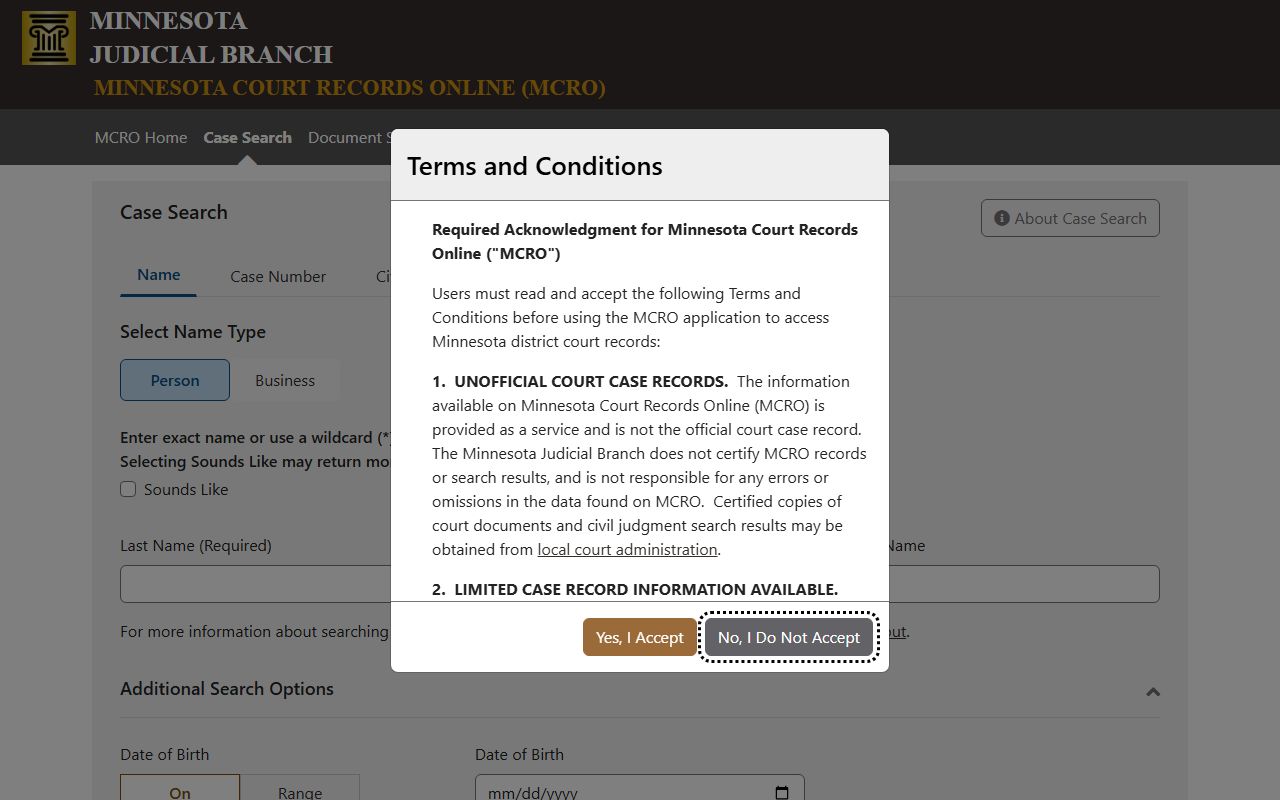
MCRO is the main online starting point for filed charges, but certified copies still come from court administration.
Minnesota Trial Court Records
Minnesota criminal cases are handled through the Minnesota Judicial Branch trial court system. MCRO Case Search allows searches by person name, business name, attorney name, case number, citation number, or attorney bar number. Public online records may include the register of actions, case events, hearing settings, party names, charge details, dispositions, sentences, warrants, and public documents that are available remotely. The Judicial Branch also warns that online records are not the official court case record.
The county still matters. A person arrested in one county is usually booked by that county or by a regional facility serving it, and charges normally appear in the trial court tied to that county or case venue. The Minnesota County Directory helps route the custody side, while MCRO handles the statewide court-search side. When a case is sealed, restricted, juvenile, or otherwise not available remotely, court administration is the official source for what can be released.
Find Court Records After Arrest
The search process is simple when the name and county are known. Start with MCRO, then compare the court case to the jail roster or MNDOC record if custody status matters. A charge may be public in court while the person is no longer in jail. The reverse can also happen for a short time after arrest, when a county jail roster appears before the prosecutor's court filing is visible online.
- Open MCRO Case Search and search by person name, case number, citation number, or other supported field.
- Filter or review results by county, case type, filing date, and defendant details to avoid mixing people with similar names.
- Open the criminal case and review the register of actions, charge list, hearing dates, warrant status, and public documents.
- Compare the filed court charge to the booking charge if a jail roster still lists the person in custody.
- Request certified court records from local court administration if an official copy is needed.
The Minnesota law-enforcement data statute is the statewide law that helps explain why arrest data and some booking details can be public before a court case is complete.
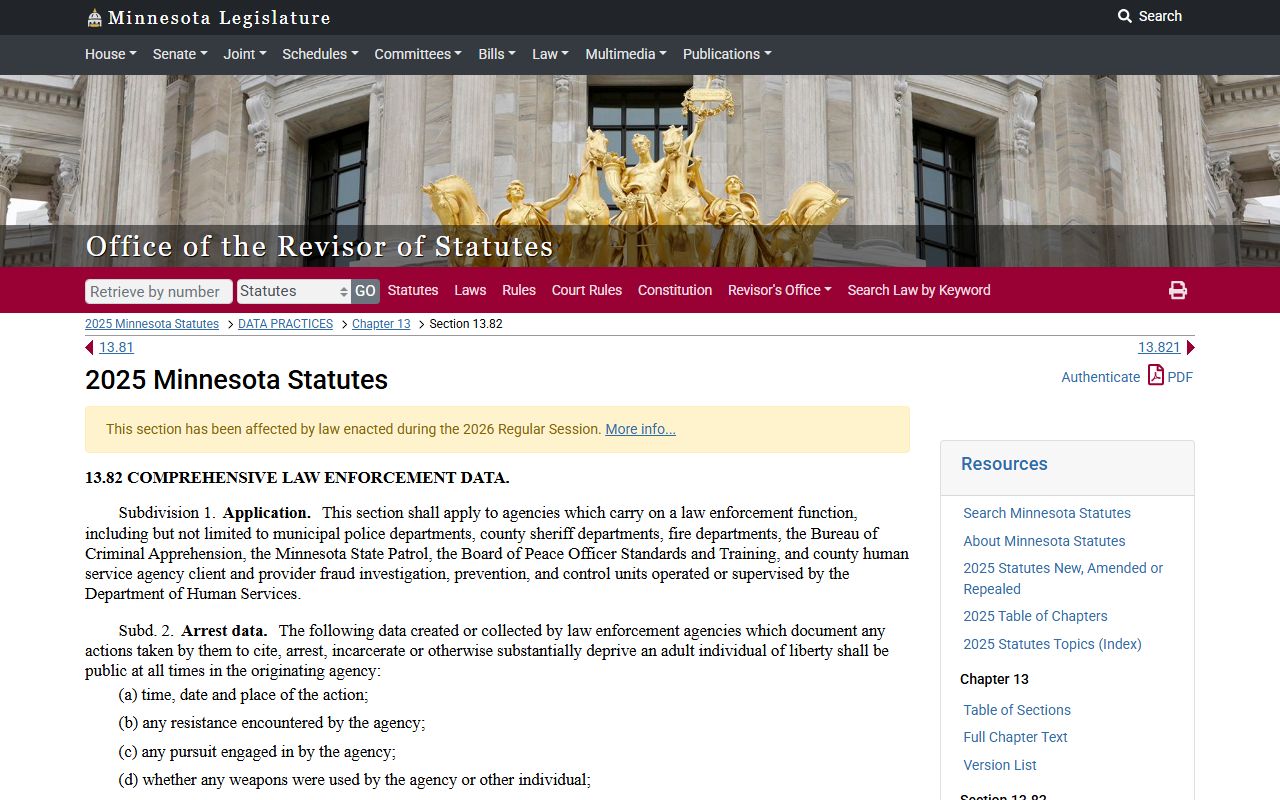
That arrest-data law supports public booking information, but it does not replace the court case record filed after arrest.
Minnesota Charging Documents
A charge becomes a court record through a formal filing. In common language, people often call everything an arrest record. For Minnesota court records after a jail arrest, the more useful question is which charging document opened the case and what charges are listed there. The document may describe probable cause, statutory counts, offense level, date ranges, victims or protected parties when public, and the prosecutor's theory of the case.
| Document | Filed By | Common Use | What to Check |
|---|---|---|---|
| Complaint | Prosecutor, based on sworn facts | Many Minnesota criminal cases | Counts, probable-cause statement, offense level, and summons or warrant details |
| Information | Prosecutor | Some felony or post-waiver filings | Charge language, amended counts, and case status |
| Indictment | Grand jury | Serious felony matters where required or used | Counts returned by the grand jury and later amendments |
MCRO may show public documents online, but document access can vary by case type, record classification, remote-access rule, and local filing practices.
Minnesota Charge Status
Charge status changes as a case moves. A pending charge is an accusation, not a conviction. An amended charge means the prosecutor or court record changed the count. A dismissed count is no longer being pursued in that case, though other counts may remain. A conviction follows a guilty plea, verdict, or other finding. A sentence can lead to probation, jail, work release, treatment, prison commitment, supervised release, or other lawful terms.
| Status | What It Means | Search Tip |
|---|---|---|
| Pending | The filed charge is active and has not reached final disposition. | Check future hearings and warrant status. |
| Amended | The original charge was changed, reduced, added to, or replaced. | Compare the current charge list to the booking charge. |
| Dismissed | The court record shows that a count or case was dismissed. | Read whether all counts or only one count ended. |
| Convicted | A plea or finding resulted in a conviction on that count. | Check sentence, custody, probation, and release terms. |
| Warrant or hold | The court or another agency has a custody-related order or detainer. | Confirm with the court or holding agency before acting. |
Bond After Minnesota Arrest
Bond and release terms often bridge the jail record and the court record. A county jail roster may show a bond amount or no-bond hold, while the court record shows the order that controls release. Conditions can include cash bail, conditional release, no contact orders, testing, reporting, travel limits, or holds for another warrant. If a person is held for another county, federal agency, DOC warrant, or ICE matter, the local court case may not be the only reason the person remains in custody.
| Release Term | How It Works | Where to Verify |
|---|---|---|
| Cash bail | Money is posted with the court or jail under the court's order. | Court administration or the holding jail. |
| Conditional release | The person can be released if court-ordered conditions are followed. | MCRO and local court administration. |
| Recognizance release | The person is released on a promise to appear, sometimes with conditions. | Case events and release order. |
| Hold or detainer | Another court, agency, DOC, federal authority, or ICE may require custody. | The agency that placed the hold. |
Charges Versus Convictions
A Minnesota arrest does not prove guilt. A filed court charge is an accusation that must move through the court process. A conviction is a later result based on a plea, verdict, or other finding. This distinction matters for employment, licensing, housing, sentencing, immigration, and public-record interpretation. Public access to a charge does not mean the person was convicted, and a dismissed case may still require careful reading of the court record.
| Charge | Conviction | |
|---|---|---|
| Stage | Filed accusation after investigation or arrest | Final or case-level result after plea, verdict, or finding |
| Custody link | May explain a jail booking or warrant | May lead to jail, prison, probation, or supervised release |
| Public meaning | Shows what the prosecutor alleged | Shows what the court found or accepted |
Important: Do not treat a jail arrest, pending charge, dismissal, and conviction as the same legal result.
Sealed Minnesota Arrest Records
Some court records after an arrest may be sealed, expunged, restricted, or unavailable online. Minnesota public-records law also limits access to juvenile data, victim data, medical information, security details, and certain investigative or private data. A sealing or expungement order can change what appears in public court systems and in agency responses, but it does not mean every third-party copy or every agency note disappears at the same time.
| Sealed or Restricted | Expunged | |
|---|---|---|
| Public access | Hidden or limited for public viewing by rule or order | Access narrowed under the expungement order and applicable law |
| Agency access | Some justice agencies may retain access when authorized | Access depends on the scope of the order and statute |
| Search result | May not appear in MCRO remote search | May be removed, hidden, or limited from public response |
The Minnesota DOC offender-records page is a separate route for DOC-held record questions when a case has moved into state correctional custody.
Court sealing questions and DOC custody-record questions often involve different offices, even when they arise from the same criminal case.
Court Records and Custody
Court records after a Minnesota jail arrest can point toward county jail custody, MNDOC custody, federal custody, or immigration custody. A sentence to the Commissioner of Corrections moves the prison search to MNDOC. A federal prosecution moves custody lookup toward BOP once the person is in federal prison. An immigration hold or transfer can make the ICE detainee locator relevant. Minnesota VINE can help with county jail notification, while DOC custody notification follows DOC's own route for sentenced prisoners.
When the case record identifies a jail, prison, workhouse, federal site, or regional detention center, the Minnesota Facility Directory is the better route for deciding which custody system controls visits, mail, phone access, records requests, and public locator results.
The Minnesota executed felony sentencing statute explains the two-part structure for many modern felony prison sentences.
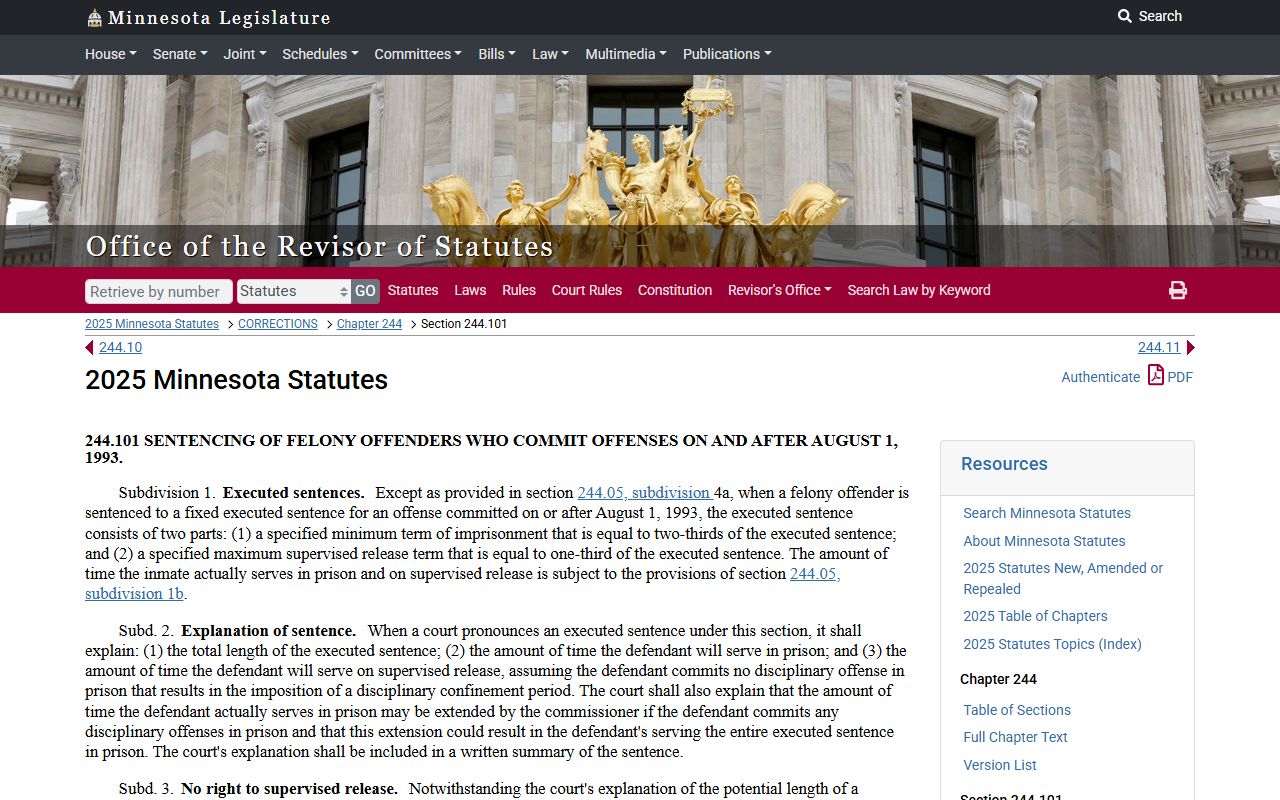
That sentencing framework is one reason a court conviction can shift the correct lookup tool from a county roster to MNDOC.
Restricted Court Records After Arrest
Remote access has limits. MCRO may not show every document, every sealed event, every juvenile matter, or every record classified as nonpublic. Minnesota Statutes chapter 13 allows public access to government data unless another law classifies the data otherwise, and the law-enforcement, corrections, and detention statutes create more detailed rules. If an online court record is missing, the reason may be data classification, remote-access limits, timing, name mismatch, county filing delay, sealing, or a case that was never charged.
Records after arrest should be checked at the source before any major decision. Use MCRO and court administration for court case records. Use the county roster for current jail custody. Use MNDOC for state prison and supervision records. Use BOP or ICE for federal and immigration detention. Use Minnesota VINELink only for notification functions it actually supports.
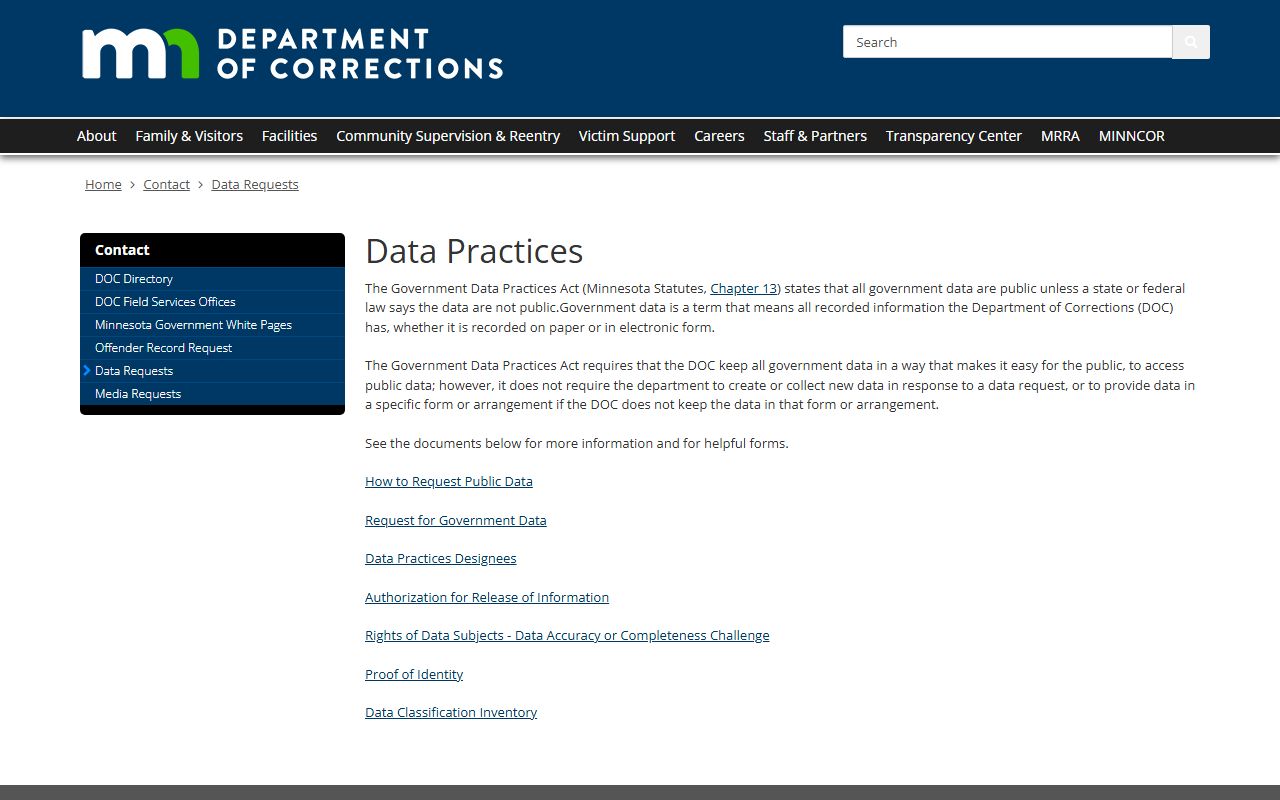
The Minnesota DOC Data Requests page shows how public-data requests work when the state corrections agency holds the relevant record.
For county jail records, the same chapter 13 public-data framework is applied by the county or sheriff that maintains the booking record.