
What Is MNDOC?
MNDOC is used here for the Minnesota Department of Corrections public locator and search convention. The agency's own FY25 Performance Report spells out Minnesota Department of Corrections and then uses DOC, while site text also uses MN DOC. The public search page is branded as the MNDOC Locator and refers to a MNDOC Offender ID. For search intent, MNDOC inmate population and MNDOC inmate search are the clearest phrases, with Minnesota Department of Corrections defined on first use.
The Department of Corrections central office is at 1450 Energy Park Drive, Suite 200, St. Paul, Minnesota 55108, phone 651-361-7200. That is an administrative contact, not a visiting address for an incarcerated person. Facility visiting, mail, phone, and money rules belong to the facility that holds the person. County jail questions belong to the county jail or sheriff, while state prison and supervision questions belong to MNDOC records channels.
The Minnesota Department of Corrections home page is the official statewide agency entry point for locator, statistics, facility, visiting, notification, and public-resource navigation, and it confirms that MNDOC prison custody is separate from local jail rosters.
The MNDOC Inmate Population
The latest population figure in the research is 8,160 adult incarcerated people as of January 1, 2026, in the Minnesota DOC Adult Prison Population Summary. The previous July 1, 2025 summary and FY25 Performance Report gave 8,286. That means the latest short-term comparison shows 126 fewer people, a decline of about 1.5 percent. The January summary also broke the population down by sex, offense type, county of commitment, facility location, admissions, and release transitions.
State prison population should not be mixed with DOC community supervision. The FY25 Performance Report reported 17,734 people on DOC supervision excluding CCA and CPO supervision, plus 16,928 adults and 806 juveniles under DOC community supervision on July 1, 2025. Those are supervision counts, not people physically incarcerated in prison. The MNDOC inmate population phrase on this page refers to the in-custody prison population unless a supervision record is named.
| Measure | Figure | Source / Date |
|---|---|---|
| MNDOC inmate population, in custody | 8,160 | Adult Prison Population Summary, January 1, 2026 |
| Earlier adult incarcerated population | 8,286 | Adult Prison Population Summary and FY25 Performance Report, July 1, 2025 |
| Male / female breakdown | 7,574 male; 586 female | Adult Prison Population Summary, January 1, 2026 |
| DOC adult facilities | 11 | DOC facilities page and FY25 Performance Report |
The DOC statistics page links the current Adult Prison Population Summary and daily profile reports.
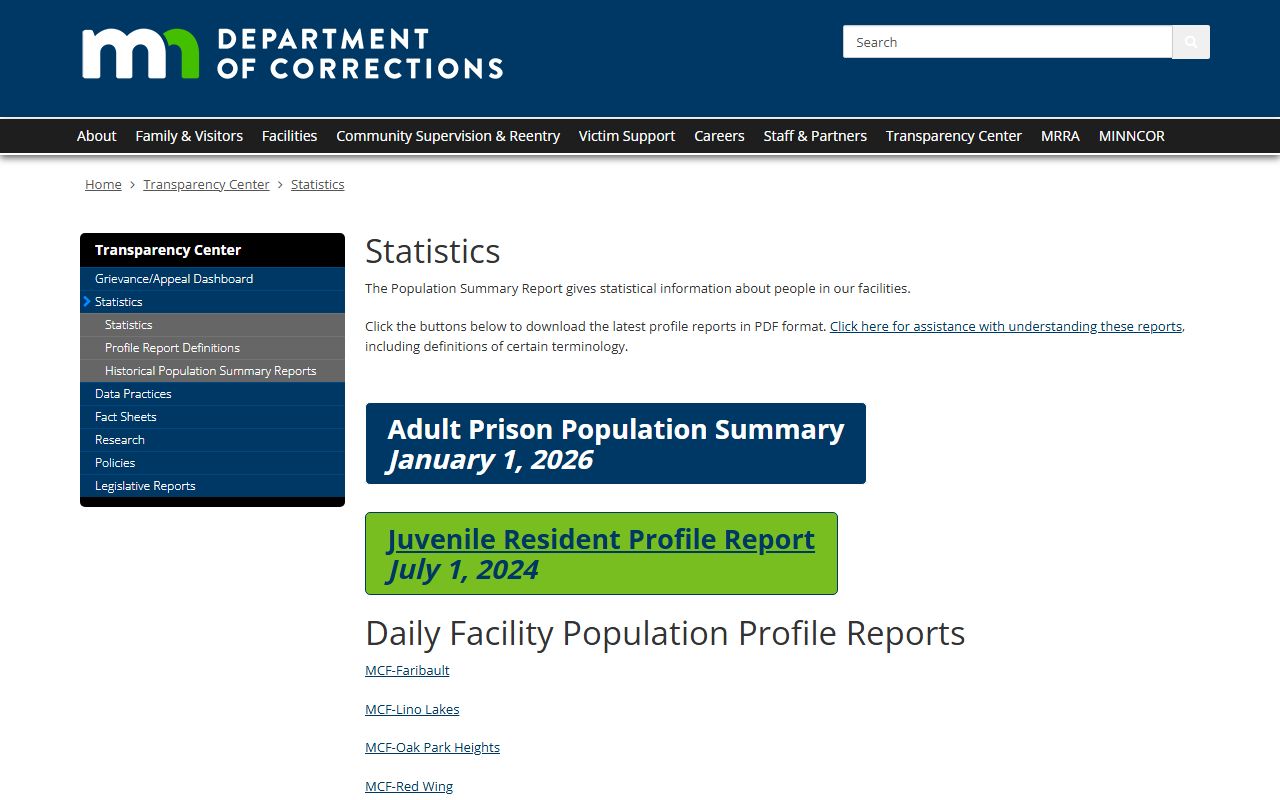
Those statistics support population research, while the locator itself supports name and ID searches.
How to Search the MNDOC Inmate Locator
The MNDOC Locator retrieves public information about adults committed to the Commissioner of Corrections and still under Department of Corrections jurisdiction. The research notes that this includes people in prison and people released from prison but still under supervision. It excludes most fresh county jail bookings, city lockup cases, people held only for local warrants, and people released with no remaining DOC jurisdiction.
- Open the official MNDOC Locator.
- Choose a name search or a MNDOC Offender ID search.
- For a name search, enter first name, last name, or both. The locator help says the search includes names beginning with the letters typed and associated conviction names, including AKA names.
- For an ID search, enter the full six-digit MNDOC Offender ID. Partial IDs do not return results.
- Review the public profile and related links for court, BCA, notification, registrant, or fugitive information when they appear.
The public MNDOC Locator is the direct search screen for state prison and DOC supervision records.
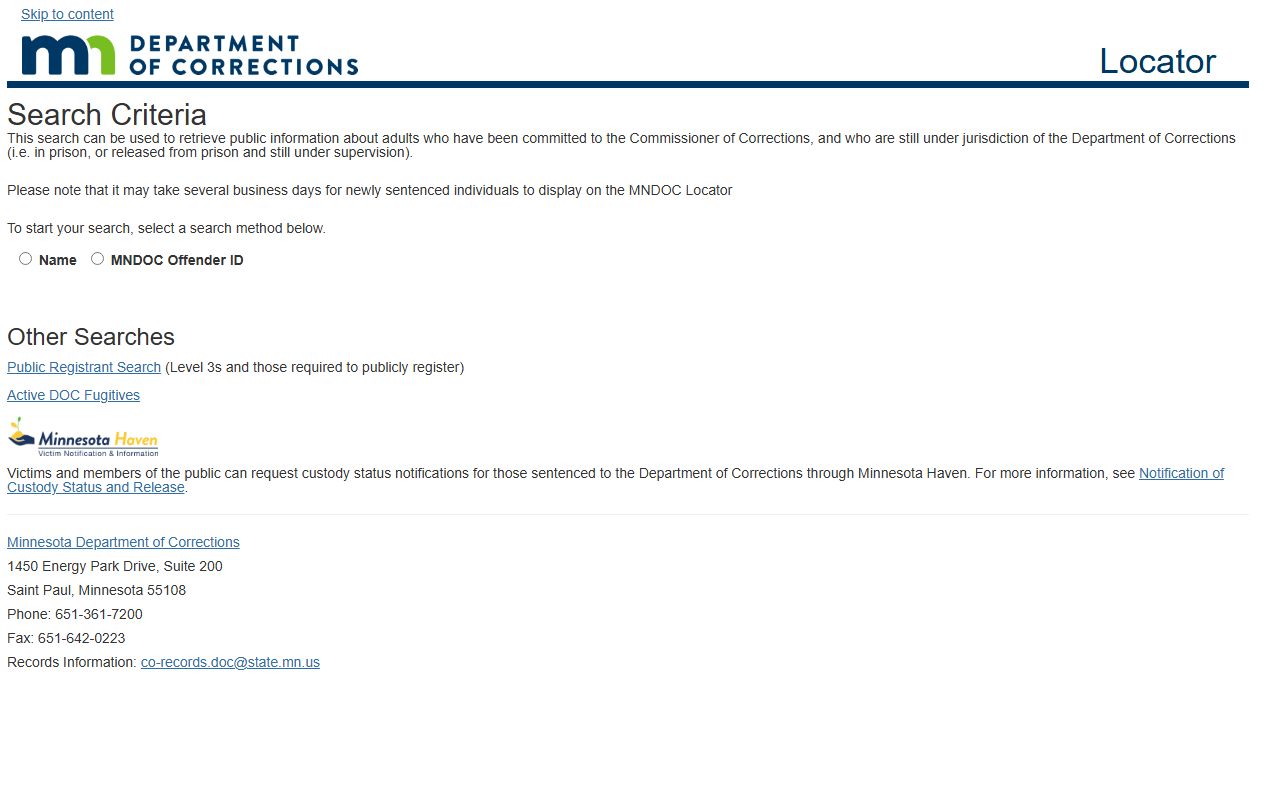
The several-business-day display warning is important when a person has just moved from county jail to DOC intake.
MNDOC Inmate Record Fields
A MNDOC inmate record is different from a county booking sheet. It is tied to DOC jurisdiction, not just to an arrest. The public record may identify a person by name and MNDOC Offender ID and may show custody status, facility, public offense or sentence information, and links to related public systems. Exact fields can change with the profile and custody status, so the profile should be read with the current locator screen rather than assumed from a county jail roster.
| Field | What It Shows |
|---|---|
| MNDOC Offender ID | The six-digit identifier used for exact DOC searches. |
| Name and AKA history | The locator help says name searches include associated conviction names and AKA names. |
| Custody or supervision status | Whether the public record is tied to current prison custody or remaining DOC jurisdiction. |
| Facility or location | The DOC prison, work release, community work crew, or other location when reported. |
| Related public links | Potential court, BCA, notification, registrant, or fugitive links shown by the locator. |
Note: Newly sentenced individuals may take several business days to display after transfer or DOC intake.
MNDOC Prisons and Facilities
Minnesota DOC says it operates eleven facilities. The adult facilities page lists four adult custody levels: minimum, medium, close, and maximum. Minimum custody includes Lino Lakes, Faribault, Togo, Willow River, and adult Red Wing. Medium custody includes Lino Lakes, Moose Lake, and Faribault. Close custody includes Rush City, St. Cloud, and Stillwater. Maximum custody is Oak Park Heights. Shakopee is the only prison housing females of all custody levels.
The January 1, 2026 population summary listed facility and location counts for Faribault, Lino Lakes, Moose Lake, St. Cloud, Rush City, Shakopee, Stillwater, Oak Park Heights, Willow River, Togo, Red Wing, work release, institution community work crews, and short-term non-DOC correctional facility placement. The DOC facility count remains eleven, but the population summary also tracks non-facility locations that matter to custody status.
| Facility / Location | Population in Summary | Notes |
|---|---|---|
| Faribault | 1,964 | Largest listed facility count in the January 2026 summary |
| Lino Lakes | 1,246 | Minimum and medium custody context |
| Moose Lake | 1,022 | Medium custody context |
| St. Cloud | 986 | Close custody and male intake context in county research |
| Rush City | 983 | Close custody context |
| Shakopee | 572 | Only facility housing females of all custody levels |
The MNDOC adult facilities page gives custody levels and facility groupings for Minnesota prisons.
The statewide facility directory adds county jail, federal, regional, and gap-researched facilities around that prison system.
MNDOC Sentencing and Release
Minnesota uses determinate sentencing for most modern felony prison sentences. Minnesota Statutes section 244.101 says that, except as provided in section 244.05, subdivision 4a, an executed felony sentence for an offense committed on or after August 1, 1993 has two parts: a minimum term of imprisonment equal to two-thirds of the executed sentence and a maximum supervised-release term equal to one-third. That is the core modern rule to use instead of calling every release parole.
Section 244.05 covers supervised release, parole, disciplinary confinement, and earned incentive release framework. The Minnesota Rehabilitation and Reinvestment Act page describes an earned earlier-release pathway tied to individualized programming, demonstrated change, and public-safety requirements. The research cautions that MRRA should be described as an earned release-credit pathway under development or implementation, not as an automatic universal release rule.
The Minnesota sentencing law explains the two-thirds imprisonment and one-third supervised-release structure for many executed felony sentences.
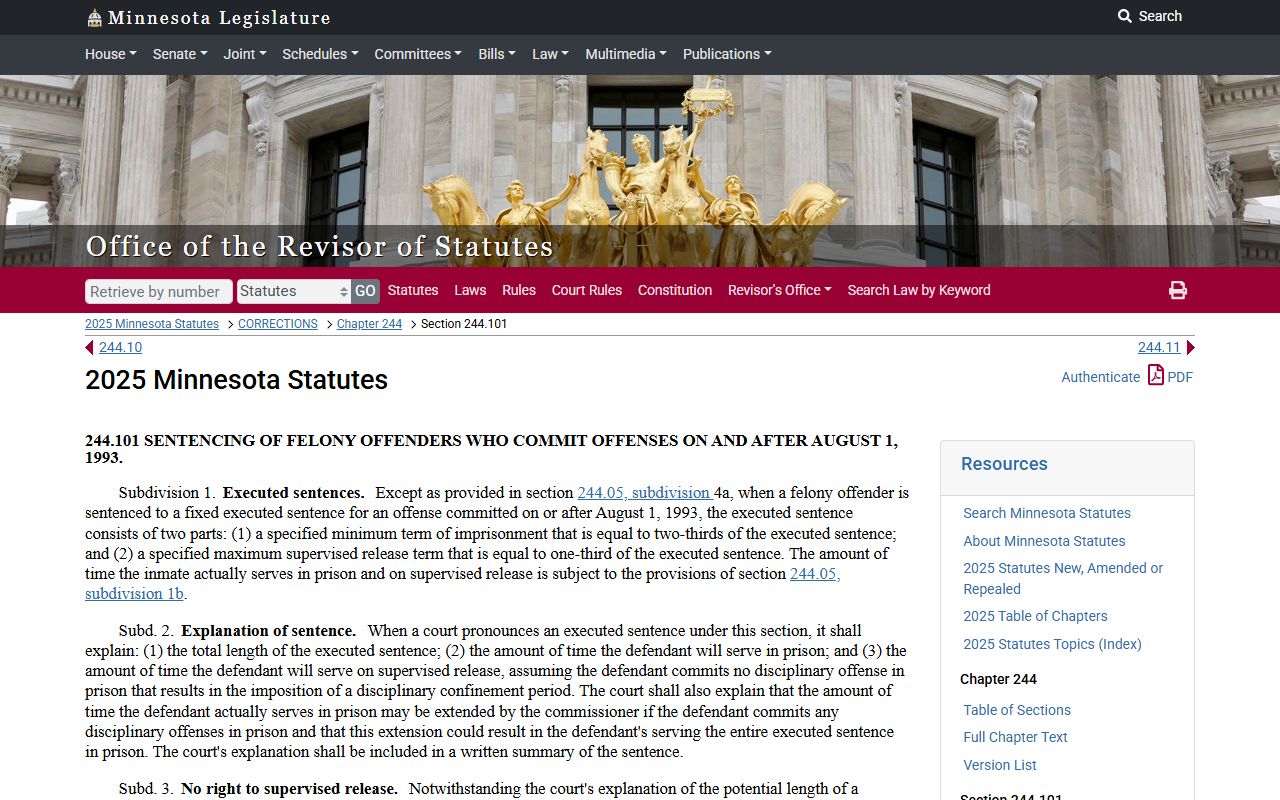
That statutory split is one reason DOC custody, release dates, and county jail release rules should be kept separate.
The Minnesota Rehabilitation and Reinvestment Act page describes earned earlier-release concepts and public-safety requirements. Use MRRA wording carefully because eligibility and credits depend on statute, DOC implementation, and individual case facts.
MNDOC vs County Jail Search
The MNDOC inmate population is not the same as the county jail population. County rosters may show booking date, arresting agency, charge, bond, projected release date, housing status, court date, and booking photo depending on the local system. The MNDOC Locator is for adults committed to the Commissioner of Corrections and still under DOC jurisdiction. It may also include supervision records after prison release. A person can disappear from a county roster before the MNDOC profile appears, especially during intake or transfer.
| MNDOC State Prison | County Jail | |
|---|---|---|
| Who is held | Sentenced state prisoners and DOC supervision records | Recent arrests, pretrial detainees, local sentences, and local holds |
| Main search | MNDOC Locator | County jail roster or sheriff records office |
| Primary law frame | Corrections and detention data plus DOC records rules | Law-enforcement data, sheriff jail records, and local jail standards |
| Routing path | DOC locator and records pages | Minnesota County Directory |
MNDOC Records Requests
DOC records requests are separate from locator searches. The DOC Data Practices page says the Government Data Practices Act requires DOC to keep government data so public data are easy to access, but it does not require DOC to create or collect new data or provide data in a form the department does not keep. Public requests should use the DOC data request page and forms. Offender-record questions can use the Records Management path documented in the research.
The offender-record page lists Records Management phone 651-361-7330, fax 612-473-5006, and email CO-Records.DOC@state.mn.us. Those contacts are for DOC record questions, not for county jail bond, local visitation, or court-certified records. County jail booking records go to the holding county sheriff or county data-practices office. Court-certified records come from court administration.
The Minnesota DOC Data Requests page describes public-data request forms and chapter 13 access limits.
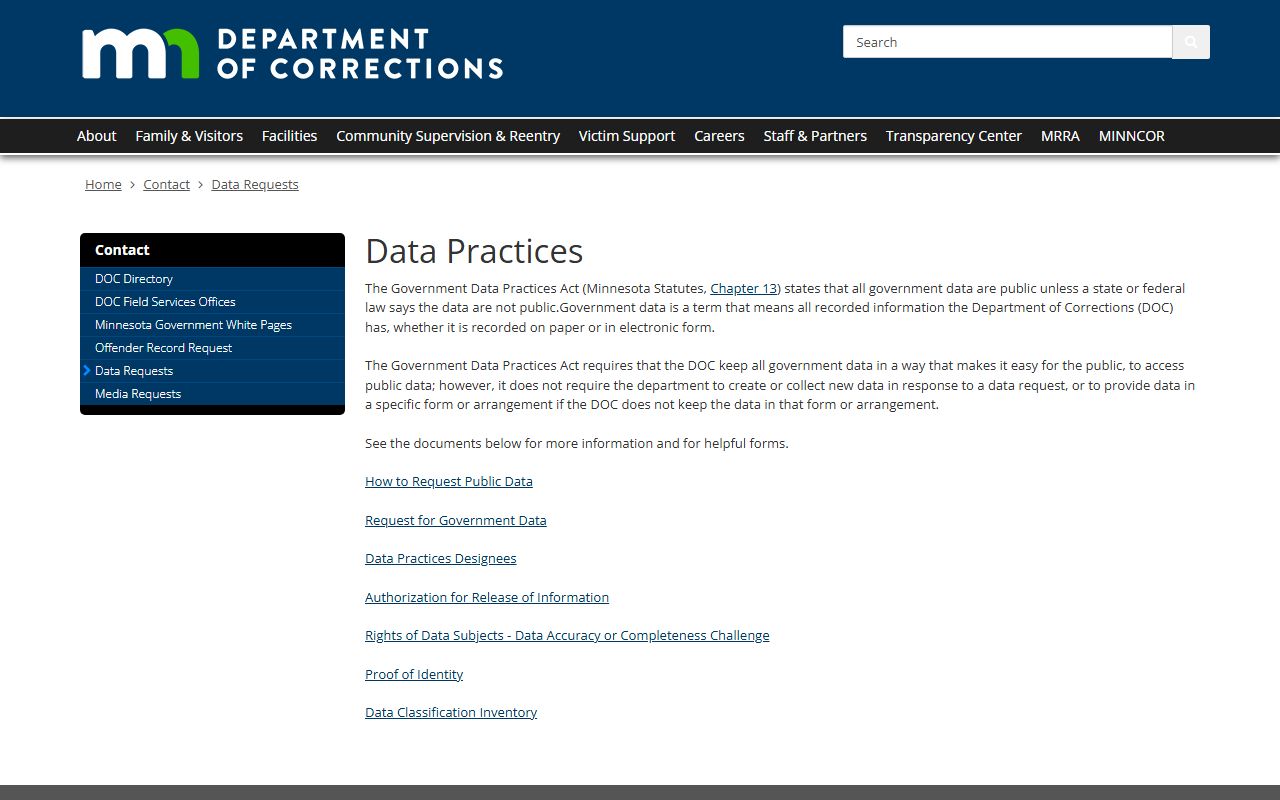
Use that route for DOC-held government data, then use county or court offices when the record belongs to another agency.
The MNDOC offender records page gives Records Management contact details for offender-record questions.
That record contact is most useful when the online locator does not answer a DOC-specific public-record question.
MNDOC Inmate Population FAQ
How large is the MNDOC inmate population?
The latest researched total is 8,160 adult incarcerated people as of January 1, 2026, from the DOC Adult Prison Population Summary. That is 126 fewer than the July 1, 2025 DOC figure of 8,286.
Does the MNDOC Locator show county jail inmates?
No. The locator covers adults committed to the Commissioner of Corrections and still under DOC jurisdiction. Recent arrests and pretrial detainees are searched through the holding county's jail roster or sheriff records path.
What if a sentenced person is not showing yet?
The locator warns that newly sentenced individuals may take several business days to display. Check the county roster, the court case, and DOC records channels when a transfer has just happened.