
How Minnesota Inmate Records Work
Minnesota does not run one master public jail roster for every county jail. County sheriffs and county corrections departments keep the local jail records for people booked after arrest, held before trial, serving short local sentences, waiting for transport, or held for another agency. The statewide directory exists because each county uses its own roster style, custody label, and records contact path. Some counties have a named detention center, some use a regional jail, and a few route full custody to a contract jail while the local sheriff handles booking, holding, or transport.
State prison records are different. The Minnesota Department of Corrections, also called MNDOC for locator search purposes, keeps records for adults committed to the Commissioner of Corrections and still under DOC jurisdiction. The MNDOC Locator can show people in prison and people released from prison but still on supervision. It is not the right first stop for most fresh jail bookings. A person can be in a county roster one day, move through sentencing or transfer, and then appear later in MNDOC after intake and data entry.
The official MNDOC Locator page shows the search scope and name fields used for sentenced state custody.
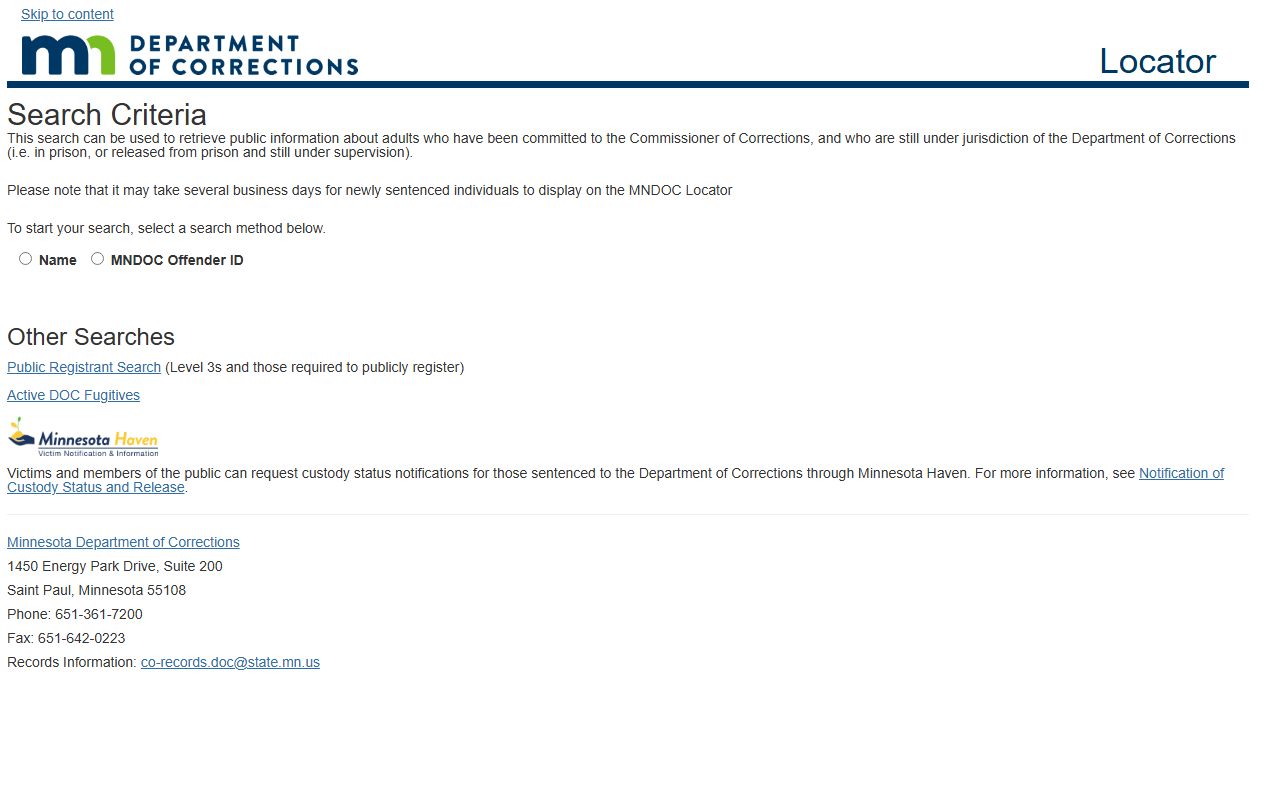
That state locator is most useful after a felony sentence, revocation, or supervised-release status places the person under DOC jurisdiction.
Find Minnesota Inmates Statewide
The cleanest lookup path starts with custody type. If the person was just arrested, search the county that booked the arrest. If the person was sentenced to prison, search MNDOC. If the case is federal, use the Bureau of Prisons. If the hold is immigration related, use ICE. If the question is not location but charge history, move to Minnesota Court Records Online. These systems overlap in real life, but each one answers a different public-record question.
- For a sentenced state prisoner or a person still on DOC supervision, search the MNDOC Locator by name or six-digit MNDOC Offender ID.
- For a recent arrest, identify the booking county and open that county's jail roster through the Minnesota County Directory.
- For a physical place of confinement, use the Minnesota Facility Directory to distinguish county jails, workhouses, state prisons, federal prisons, juvenile centers, and regional facilities.
- For federal prison custody, search the BOP inmate locator by name or federal number.
- For immigration custody, use the ICE Online Detainee Locator System with A-number details or name, country of birth, and birth date.
- For release notification from many county jails, use Minnesota VINELink, while DOC custody notification follows the separate DOC notification route.
The Minnesota VINELink state page is the statewide notification channel tied to many county jail custody events.
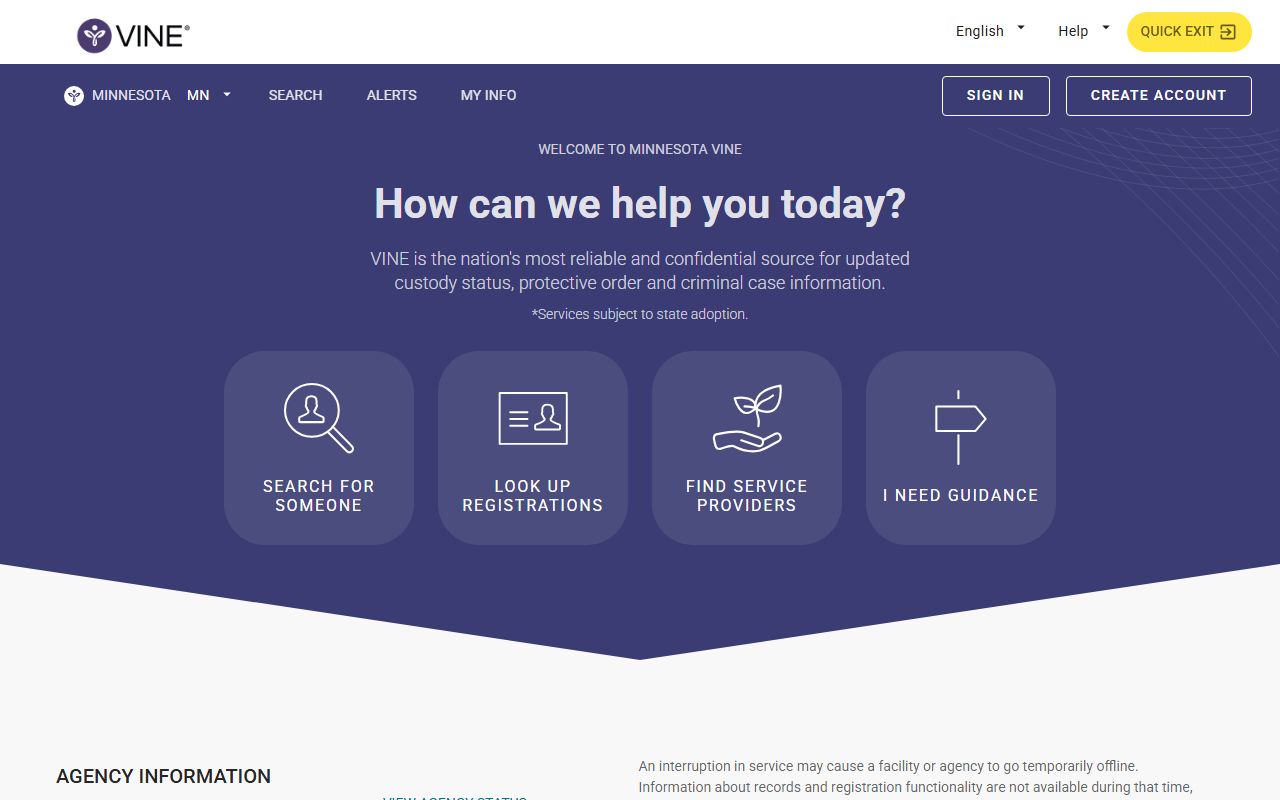
VINELink is a notification tool, not a complete criminal case file or a substitute for the holding county roster.
Minnesota Custody Systems Compared
Many bad searches come from using the right name in the wrong database. County jail records, MNDOC records, BOP records, ICE records, and court records can all describe the same person at different stages. A booking record is tied to the jail intake event. A DOC record is tied to a sentence and state jurisdiction. A court record is tied to filed charges and case events. A federal or immigration record can exist even when the arrest started in Minnesota.
| Custody or Record | Run By | Where to Look | What It Covers |
|---|---|---|---|
| County jail | County sheriff or county corrections | County roster from the directory | Recent bookings, pretrial custody, short sentences, local holds, and transfers |
| State prison | Minnesota Department of Corrections | MNDOC Locator | Adults committed to the Commissioner of Corrections and still under DOC jurisdiction |
| Federal prison | Federal Bureau of Prisons | BOP inmate locator | Federal prisoners and many federal records after 1982 |
| Immigration detention | ICE | ICE Online Detainee Locator System | People currently in ICE custody or certain CBP custody beyond 48 hours |
| Criminal court case | Minnesota Judicial Branch | MCRO Case Search | Filed charges, case events, hearings, documents, and dispositions when public online |
The Federal Bureau of Prisons inmate locator covers federal custody and uses name or number search fields.
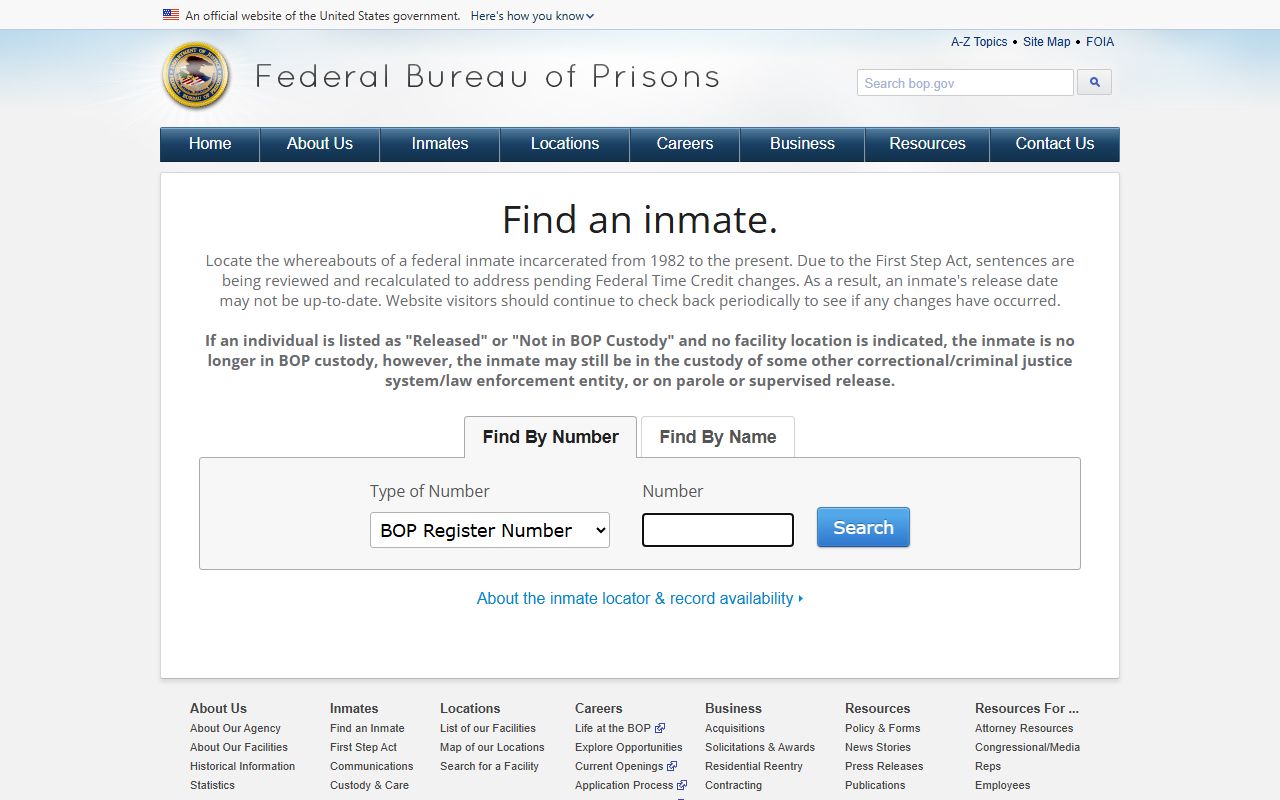
Federal results should not be read as county jail results, even when a federal detainee was once housed in a Minnesota county facility.
Minnesota Jail Roster Fields
County rosters vary because the local agency controls its own system. Still, Minnesota county jail records usually share a core set of fields. A roster can show a booking photo, name, age or date of birth, arresting agency, booking date, charges, bond, court date, warrant or hold status, housing site, and release data. Some counties show only a current-custody list. Others have PDF reports, recent-booking feeds, vendor portals, or daily custody lists.
| Field Label | Type | Typical Use | Notes |
|---|---|---|---|
| Last name and first name | Text search | Find a current booking | Name spelling matters, but some systems allow partial matches. |
| Booking number | Identifier | Match one jail event | Not the same as an MNDOC Offender ID or a court file number. |
| Facility or housing | Location field | Show where the person is held | Useful in counties with more than one adult custody site. |
| Charges | Case-related field | Show alleged offenses or holds | Booking charges can change after the prosecutor files court charges. |
| Bond or release status | Custody status | Explain why the person remains held | Confirm bond and release terms with the court or jail before acting. |
Note: A county jail roster is a custody record, while MCRO is the better source for filed criminal case events.
Minnesota Inmate Profile Details
A public inmate profile is not the full government file. It is a public slice of custody data. Minnesota Statutes section 13.03 starts from the rule that government data are public unless state or federal law classifies the data otherwise. That does not make every jail note, medical entry, investigative detail, juvenile record, victim detail, security record, or private correctional file public. It means the agency must separate public data from data that law protects.
| Field | What It Shows |
|---|---|
| Booking or DOC number | The identifier assigned by the jail, DOC, or federal system for that custody record. |
| Booking or admission date | The intake date for a county booking or a prison admission record. |
| Charges or offense group | The listed arrest charges, court charges, sentence offense, warrant, hold, or DOC offense category. |
| Bond or sentence status | Local release conditions, a hold reason, prison sentence status, supervised release, or discharge context. |
| Facility or location | The jail, detention center, state prison, federal institution, work release site, or other custody location. |
| Custody status | Whether the person is in custody, released, transferred, on supervision, or outside that system's public scope. |
The Minnesota DOC Data Requests page explains the chapter 13 process for public records held by the state corrections agency.
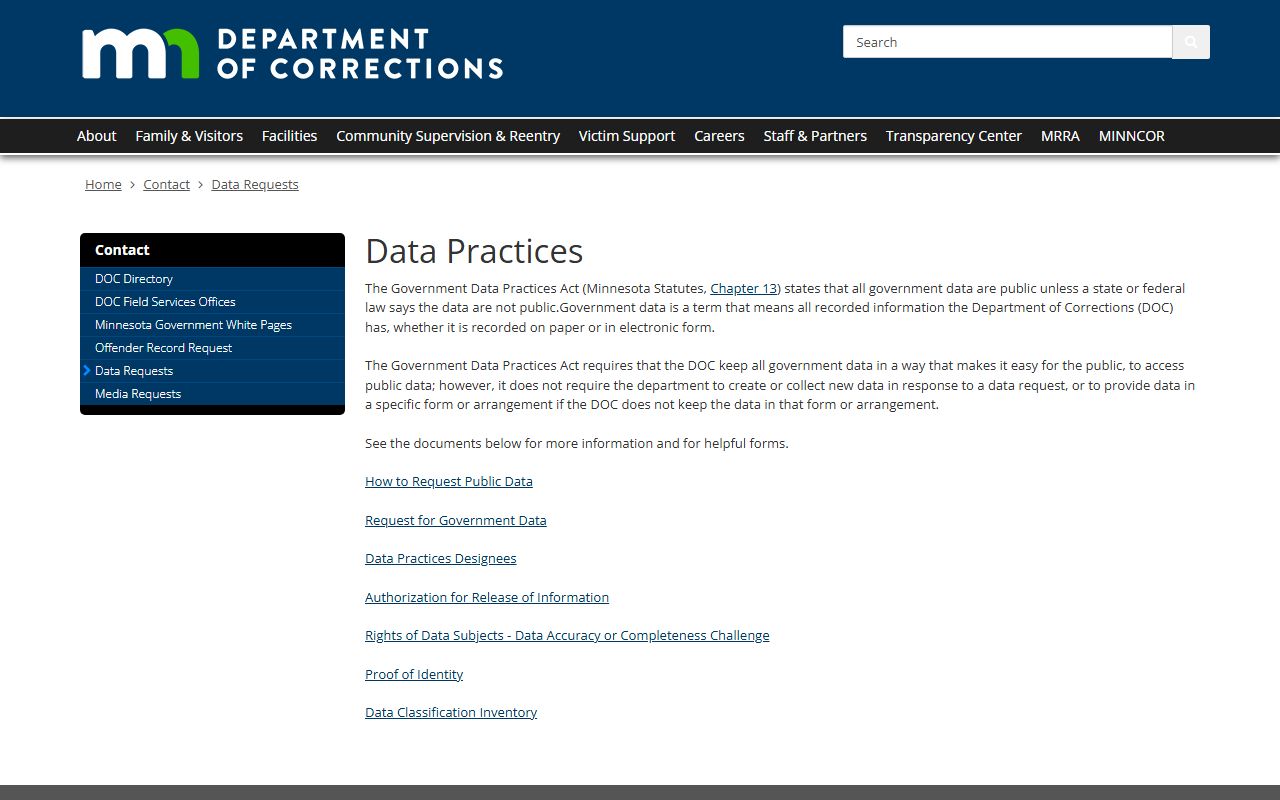
Use DOC data-practices forms for state prison data, and use the holding sheriff or county data-practices office for county jail records.
Minnesota Records Law
Minnesota inmate records are shaped by several state laws at once. Section 13.03 is the general public-data rule. Section 13.82 governs law-enforcement data, including many arrest data fields and booking photographs when no temporary active-investigation limit applies. Section 13.85 governs corrections and detention data. Section 641.05 requires sheriffs to keep permanent records of people committed to jail. Section 241.021 and Minnesota Rules chapter 2911 give DOC the inspection and licensing framework for local adult detention facilities.
- Government Data Practices Act
- Minnesota's public-records framework for state and local government data.
- Law-enforcement data
- Arrest, request-for-service, incident, and booking information handled under section 13.82.
- Corrections and detention data
- Custody and supervision data classified under section 13.85, with both public and protected parts.
- Sheriff jail record
- The permanent record a sheriff must keep for people committed to jail under section 641.05.
The Minnesota local adult detention facility standards show the statewide rule set used in DOC jail inspection and licensing work.
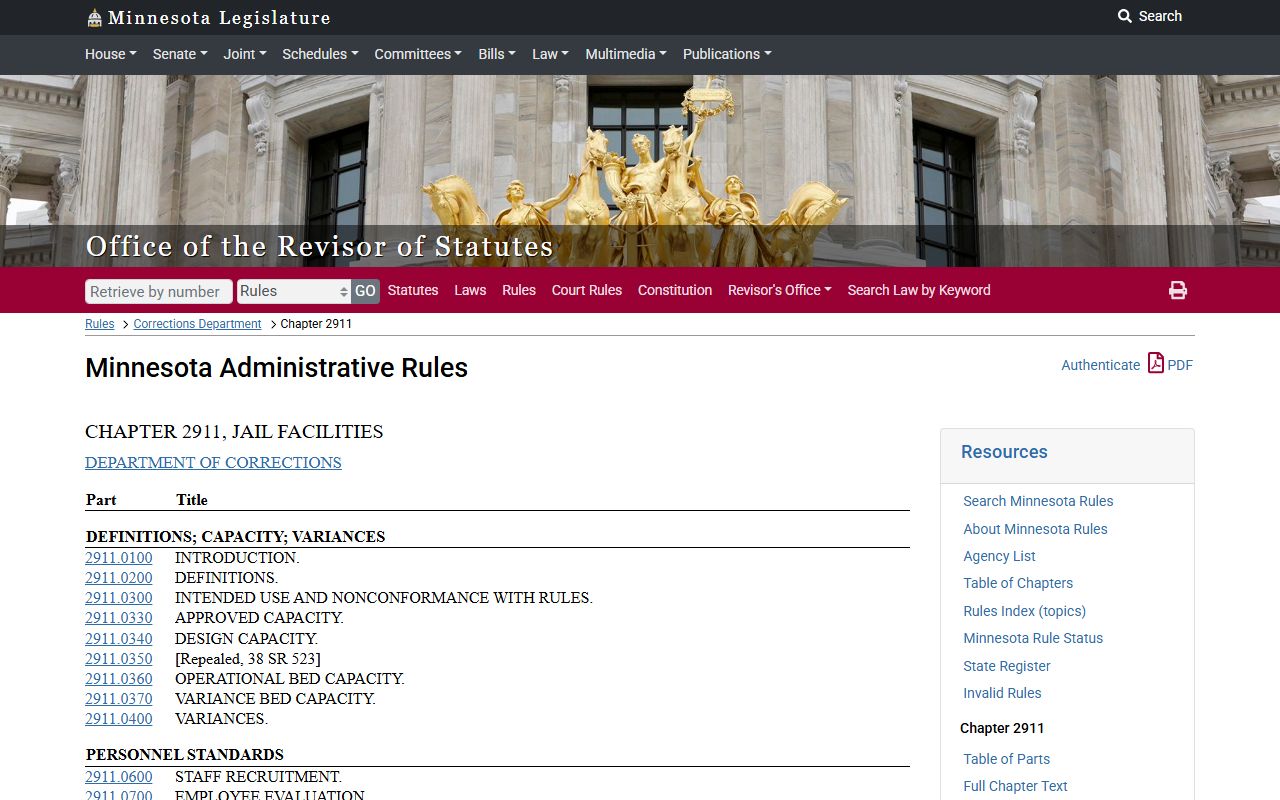
Those standards help explain why county jails are locally run but still tied to statewide detention requirements.
Minnesota Facility Rules
Visitation, mail, phone, property, commissary, and money-deposit rules are set by the holding facility. A county jail may use a county portal or a jail vendor. A state prison follows MNDOC facility policy. A federal facility follows BOP rules, and an ICE transfer can move the person into a federal detention workflow. The same person may have a county booking record, a court case, a prison locator entry, and a notification record at different times, but only the current holding agency can confirm the rules that control contact.
| Need | Best Statewide Starting Point | Why It Matters |
|---|---|---|
| Visit or video visit | Facility directory, then county or DOC facility page | Schedules, approval rules, ID rules, and vendors differ by site. |
| Send mail | Current holding facility | Mail address format and banned items depend on jail or prison policy. |
| Send money | County jail, DOC, or BOP payment channel | Each system uses its own trust-account process. |
| Check release notice | VINELink for county jail, DOC notification for sentenced custody | Minnesota VINE does not cover DOC facility notifications the same way. |
Note: Confirm custody and facility rules before visiting, sending mail, or sending funds because transfers can change the correct agency fast.
MCRO and Inmate Records
Inmate records answer where a person is held. Court records answer what criminal case has been filed after arrest. Minnesota Court Records Online, or MCRO, lets users search public court records by person name, business name, attorney name, case number, citation number, or attorney bar number. MCRO can show the register of actions and public online documents for a criminal case, but the Judicial Branch warns that remote information is not the official court case record and certified copies come from court administration.
The Minnesota Court Records Online case search is the statewide route for filed public criminal cases after a jail booking.
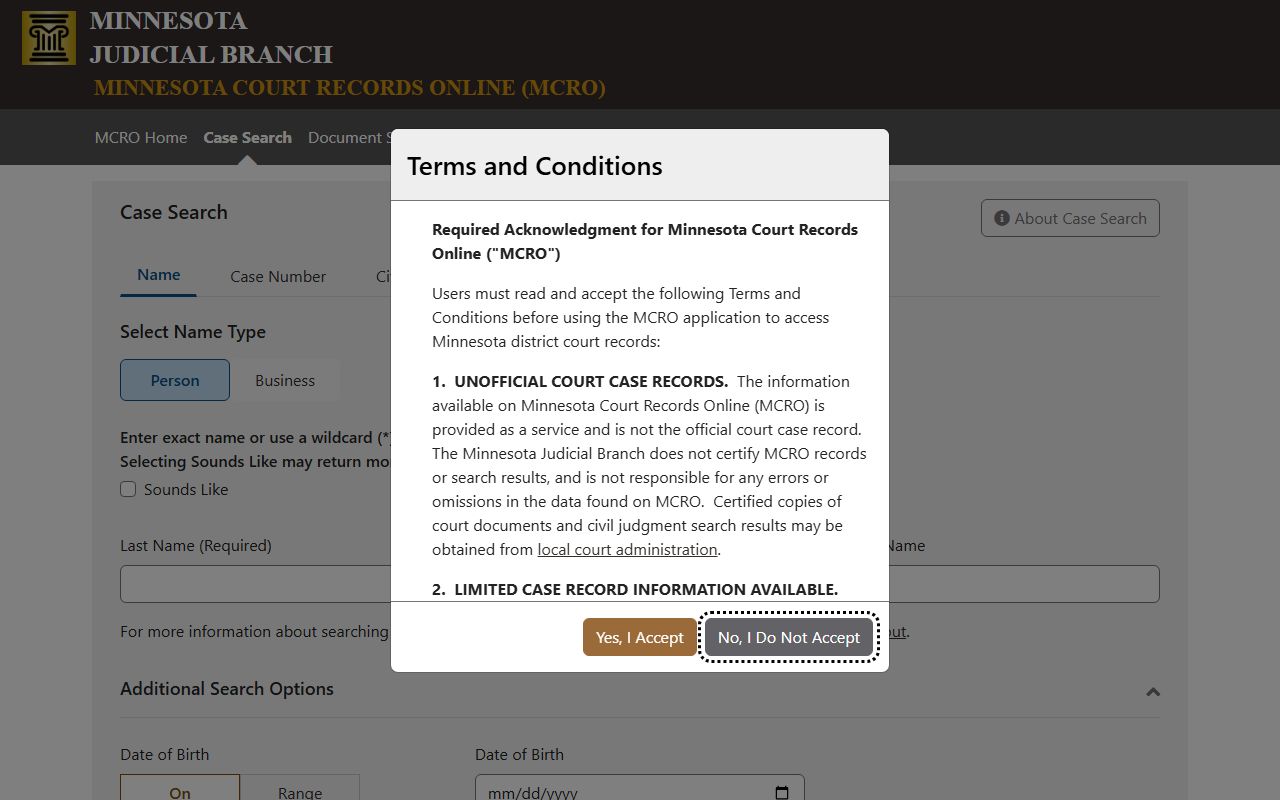
Use MCRO to track filed charges and case events, then use the county roster or MNDOC Locator to confirm custody status.